Upcoming Events
"9th ARCH_RNT SYMPOSIUM Archaeological Research & New Technologies" - Kalamata, Greece.
8-10 October, 2026.
The ARCH_RNT Symposia focus on the use of New Technologies in the Archaeological Research (Archaeometry, Computing Technology, Conservation and Restoration) notably with the presentation of interdisciplinary approaches, special case studies and research on archaeological material and assemblages.
The Symposium will be held in hybrid mode.
Special Sessions:
-
Decoding historic building materials for monument management
-
Colour and pigments: In memory of Prof. Ioanna Kakoulli
More information here.
The 13th International Round Table on Polychromy in Ancient Sculpture and Architecture on
"Polychromy and the Senses: Integrating Scientific, Cognitive, and Aesthetic Perspectives on Ancient Colour"
will be organised in collaboration with the Archaeological Museum of Thessaloniki, where it will take place from
November 18–21, 2026.
For more information, see - Next Meeting.
Past events
"MA-XRF and Combined Imaging Techniques in Heritage Science" - Paris, France.
29th September - 2nd October, 2026.
The conference aims to bring together researchers interested in MA-XRF and complementary imaging techniques for the study of cultural and natural heritage, including Reflectance Spectroscopic Imaging (RIS), Spectroscopic Luminescence Imaging (LIS), X-ray Diffraction Mapping (XRD), confocal XRF imaging (CXRF), etc.
Discussions will focus on the latest advances in instrument development, methods for evaluating data and their applications in case studies. Particular emphasis will be placed on the integration of MA-XRF with other techniques in multimodal analytical approaches.
More information here.
"Shades Of Red: From Characterization to Provenance Studies and Conservation of Red Pigments in Ancient Polychromy" - 32nd EAA Annual Meeting Athens, Greece. Session #240.
26-29th August, 2026
Organisers:
Alessia Coccato (University of Oxford)
Hilary Becker (Binghamton University, SUNY)
Simone Dilaria (University of Padua)
Since prehistory, red colour has long served as a fundamental chromatic component in ancient polychromy, widely employed not only in wall paintings but also in the decoration of statues, reliefs, and a broad range of artefacts. The sources of red pigments were multiple, encompassing naturally occurring iron-rich earths, mineral ores such as cinnabar and arsenates, and artificial lead-based compounds including red lead and massicot. Each of these materials imparted distinct optical, textural, and durability characteristics to the resulting surface layers—qualities that were well understood in antiquity. Historical sources (such as Pliny the Elder, Dioscorides, Theophrastus, Vitruvius, etc) provide information on both the economic and symbolic values of ancient red pigments, and provide technical details on their extraction, preparation and application. This session sought to investigate the multifaceted use of red pigments across diverse contexts, from their adoption in wall-paintings and mortar stratigraphies to their use in the applied polychromy of statuary, architecture and other organic or inorganic artefacts. Particular attention was devoted to studies of pigment characterization, the provenance of raw materials from mineral deposits or trade networks, technological and applicative aspects, and the long-term stability and conservation behaviour of red pigments on different supports and within varying depositional environments.
More information on the session can be found here.
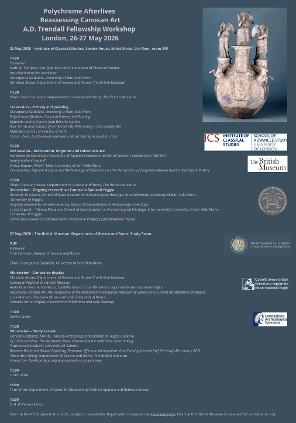
"A.D. Trendall Fellowship Workshop: Polychrome Afterlives Reassessing Canosan Art" - Institute of Classical Studies and the British Museum, London
26th May 2026, 2-6.30 pm (BST)
Bringing together specialists in South Italian archaeology, art history, and heritage science, the workshop re-examined the material, cultural, and visual significance of Canosan production. It combined thematic sessions on pottery and painting, restoration, forgeries and colour science, ongoing research and museum display. By fostering dialogue between archaeology, scientific analysis and curatorial practices, the workshop aimed to reassess the role of polychromy (understood in its broader sense) in Canosan art and to explore its ancient contexts of production and use, its impact on modern collections and its place within contemporary scholarship and museology.
Download the programme here.
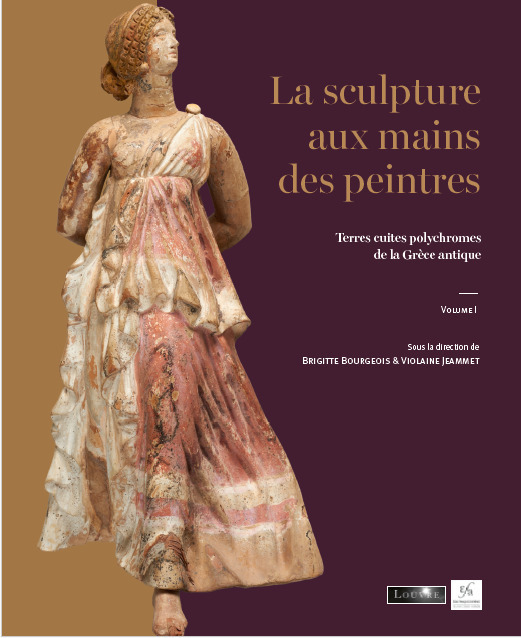
"Painters of Offerings: From Sanctuary to Tomb. Researches on an Overlooked Art from Greece to Roman Egypt" - École française d’Athènes (EfA), Athens, Greece and Online.
6th May, 2026. 9.30 am (EEST)
In conjunction with the publication of the volume La sculpture aux mains des peintres. Terres cuites polychromes de la Grèce antique, co-published by the French School at Athens and the Louvre Museum, the French School at Athens hosted a workshop devoted to the lesser-known art of painters of votive and funerary offerings in ancient Greece and in Ptolemaic and Roman Egypt.
Following an examination of the role and status of the painter as highlighted by recent research in the field of coroplastic studies, the workshop addressed the question of the transmission and adaptation of Greek technè within the multicultural context of Greco-Roman Egypt.
Download the programme here.
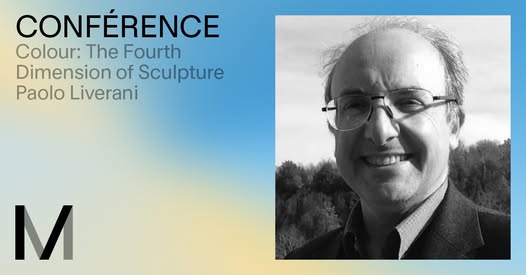
Lecture: "Colour: The Fourth Dimension of Sculpture", at the Montreal Museum of Fine Arts (MMFA).
8th April, 2026. 6 pm (EDT)
This lecture by an internationally renowned professor of archaeology, Paolo Liverani, presented the findings of research demonstrating that ancient marble sculptures were not pristinely white, but rather painted, generally in very vivid shades.
The lecture was part of the programme for: The Torlonia Collection: Masterpieces of Roman Sculpture | Exhibition | Montreal Museum of Fine Arts
Consortium working group Colour Studies Meeting - "Colour in antiquity" Online
Wednesday, April 8, 2026, 12:00 - 1:30 pm (EDT)
In this meeting, colour in antiquity was explored through recent scholarship, both from the material and theoretical perspectives. The eight invited speakers briefly presented current work-in-progress or recent results of their work on different aspects of archaeological investigation on colour. This was followed by a final discussion.
Dr. Omid Oudbashi, University of Gothenburg, Color technology in Ancient Iran.
Dr. Alexander Nagel, Fashion Institute of Technology NYC, Earth to Empire: Pigment Lumps, Materialities and Meanings of Color at Persepolis.
Dr. Andrea Sinclair, Leipzig University, The Ancient Egyptian Colour Palette: The Interplay of Iconography and Text in the Second Millennium.
Prof. Dr. Katerina Ierodiakonou, Ancient Greek philosophers on the nature and perception of colour.
Prof. Dr. Vinzenz Brinkmann, Director of Liebieghaus Frankfurt and Dr. Ulrike Koch-Brinkmann, Polichromy in ancient Greek architecture and sculpture and ancient Greek painting.
Prof. Dr. Victoria Bogushevskaya, Universita di Bergamo, Color in Ancient China.
Prof. Dr. Davide Domenici, Università di Bologna, Analysis on Mesoamerican manuscripts (precolonial) at MOLAB (Istituto di Scienze del Patrimonio Culturale-CNR).
Nuance: Dr. Alberto Virdis, Bibliotheca Hertziana (Rome)
More information here.
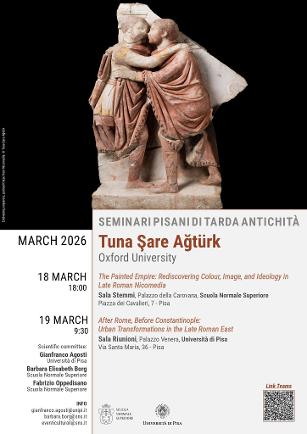
Lectures: "Seminari pisani di tarda antichità", Scuola Normale Superiore in collaboration with University of Pisa.
Tuna Şare Ağtürk (University of Oxford) gave two seminars. In person and live in Teams.
18th March, 6 pm (CET)
"The Painted Empire: Rediscovering Colour, Image, and Ideology in Late Roman Nicomedia" e After Rome, Before Constantinople: Urban Transformations in the Late Roman East The Painted Empire: Rediscovering Colour, Image, and Ideology in Late Roman Nicomedia"
19th March, 9.30 am (CET)
"After Rome, Before Constantinople: Urban Transformations in the Late Roman East The Painted Empire: Rediscovering Colour, Image, and Ideology in Late Roman Nicomedia"
More details here.
College Art Association of America (CAA) 114TH ANNUAL CONFERENCE, Chicago, Illinois.
18th–21st February , 2026
The CAA Annual Conference is the largest convening of art historians, artists, designers, curators, and visual arts professionals. Each year sessions submitted by our members, committees, and affiliated societies deliver a wide range of program content. The CAA 114th Annual Conference took place at the Hilton Chicago, February 18–21, 2026. The conference was held in person with a selection of hybrid sessions and events. Some sessions of possible interest:
Session: Art and Labor in the Ancient Mediterranean World (CAA 114th Annual Conference)
Session: Materiality and the Reception of Ancient Objects (CAA 114th Annual Conference)
Session: Ready for Her Closeup: Producing the Public Image of Ancient Roman Women (CAA 114th Annual Conference)
More information here.
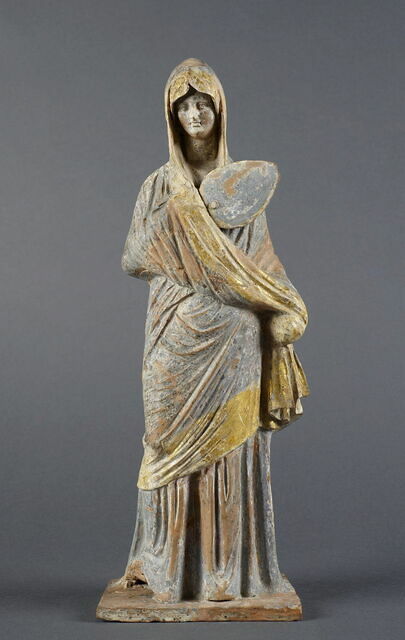
Lecture: "Le voyage des «Tanagras» : sur les pas des «Dames en bleu»" -Louvre Auditorium Michel Laclotte, Paris.
21st January 21, 2026 - 12.30 pm (EST)
Violaine Jeammet, Louvre Museum, and Brigitte Bourgeois, C2RMF
The acquisition of a painted and gilded terracotta figurine, an apparent twin of the "Lady in Blue" in the museum's collection for 150 years, provided an opportunity to revisit this group, a jewel in the crown of the Louvre's Tanagra collection. While Tanagra figurines spread throughout the Mediterranean Basin between the 4th and 3rd centuries BC, their study at the C2RMF (Centre de Recherches et de Restauration des Musées Français) and the restoration of the second "Lady in Blue" also confirm the transfer of practices and techniques.
History repeats itself: after their discovery at the Tanagra site from 1870 onwards, the Tanagras became a source of inspiration for many artists, such as Jean-Léon Gérôme, Bourdelle or Picasso.
A masterpiece from the Louvre Museum's collections, displayed on the auditorium stage, was examined up close for an hour using advanced audiovisual technology.
More information here.
The event was recorded and isavailable on YouTube.